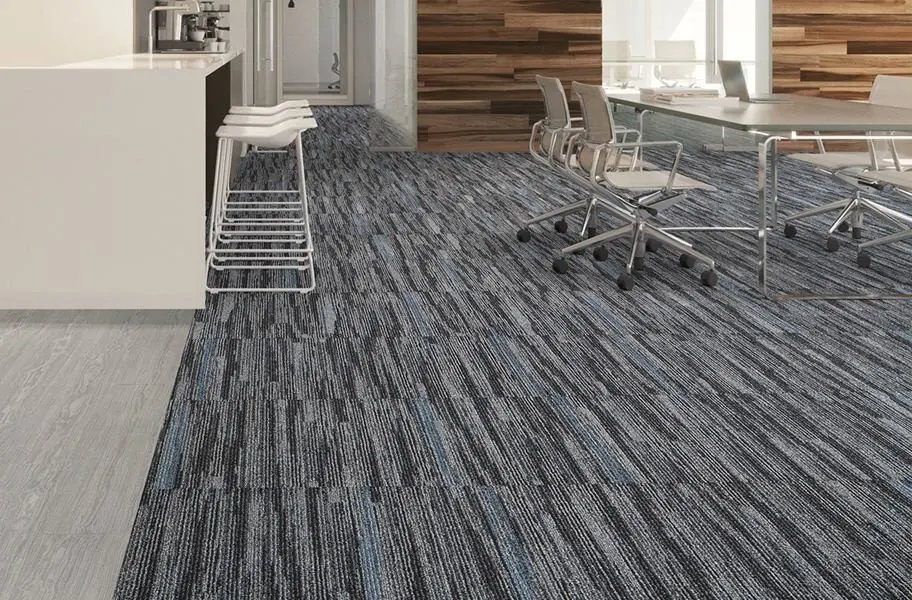
If you care about a quieter office, fewer complaints, and a space that feels comfortable underfoot, carpet tile usually wins. If you care most about easy cleaning, spill resistance, and a polished “hard surface” look, LVT (luxury vinyl tile/plank) usually wins—but only when the subfloor is flat and moisture risk is addressed.
When this matters most…
- You’re renovating an occupied office and need a plan that minimizes downtime and disruption.
- You’re getting noise complaints (open plan, call centers, conference-heavy spaces).
- You want a floor that still looks good after rolling chairs, daily cleaning, and entryway grit.
- You’re comparing bids and want the scope tight enough to avoid change-order surprises.
- You’re managing multiple tenant suites and need repeatable specs that work building-wide.
The short answer by office type
There isn’t one “best” office floor. There’s a best floor by zone and by how the office actually operates.
Open-plan offices and coworking
Pick: Carpet tile in work areas + LVT in pantries/break zones + tile in restrooms
- Why: Carpet tile controls noise and feels better for all-day use. LVT handles coffee spills and frequent cleaning better.
Common pitfalls
- Using LVT wall-to-wall in open office zones and then fighting echo and footfall noise.
- Choosing carpet tile that looks great day one but crushes and shows traffic lanes quickly.
What to specify in the quote / scope
- “Carpet tile in open office areas with performance appropriate for heavy use”
- “LVT in pantries/café zones with spill and rolling-load requirements”
- Defined transitions and edge protection at suite entries and kitchen thresholds
Private offices and executive suites
Pick: Either can work; choose based on the vibe + maintenance reality
- Carpet tile reads warm/quiet.
- LVT reads crisp/modern and is easy to keep spotless.
Common pitfalls
- Overpaying for premium visuals while ignoring underlayment, prep, and transitions (the stuff that prevents problems).
What to specify
- Clear install method (glue-down LVT vs floating)
- Attic stock strategy (extra boxes of carpet tile or LVT for future repairs)
Corridors and circulation paths
Pick: Depends on your priorities
- Carpet tile if you want quiet + fewer rolling-noise complaints
- LVT if you want faster spot cleaning and a hard-surface look
Common pitfalls
- Under-spec’ing carpet tile performance in corridors (this is where traffic lanes show first).
- Using click/floating LVT in high-traffic paths and then dealing with movement, gapping, or damaged joints.
What to specify
- Corridor performance targets (appearance retention for carpet; wear/finish + glue-down install for LVT)
- Entry mat system and protective transitions (big impact on long-term appearance)
Breakrooms, pantries, copy/print areas
Pick: LVT
- Why: Spills happen. So do coffee drips, toner dust, and frequent mopping.
Common pitfalls
- Putting carpet tile under coffee machines and expecting it to stay clean.
What to specify
- Water/spill resistance expectations, cleanability, and finish performance
- A base detail that stands up to mopping (and doesn’t trap grime)
Acoustic performance and comfort
If your goal is “make the office feel calmer,” flooring is a major lever.
Practical guidance
- Carpet tile absorbs sound and reduces the “hard echo” effect you get with hard surfaces. It also reduces footfall noise in open plan spaces.
- LVT is a hard surface, so sound tends to bounce. You can improve it with acoustic underlayments or special acoustic-backed products, but it will still behave like a hard floor.
- Comfort matters more than people admit: carpet tile feels warmer and softer underfoot, which helps in spaces where people stand, pace, or move between desks all day.
Common pitfalls
- Treating acoustics as “someone else’s problem” and then paying later with complaints, privacy issues, and a space that feels loud even when it’s not crowded.
- Assuming “acoustic LVT” automatically solves the issue. It helps, but it’s not the same as a true soft-surface floor.
What to specify in a quote / scope
- Where noise control is a priority (open office, conference rooms, corridors)
- “Carpet tile in primary work zones for acoustic control” (or acoustic-backed resilient if you must stay hard-surface)
- Underlayment/backing requirements and any coordination with furniture systems (rolling chairs, casters)
Durability and maintenance
Durability is not just “will it scratch.” It’s: how it looks after real use.
Practical guidance
- LVT durability is strongly tied to the wear layer, finish, and whether it’s installed properly over a flat substrate. It’s great against spills and routine mopping.
- Carpet tile durability is about appearance retention: fiber + construction + backing + how often it’s vacuumed and deep-cleaned. It’s forgiving day-to-day, but it’s not a “mop-and-go” surface.
Common pitfalls
- Choosing LVT for durability, then skipping subfloor prep—resulting in telegraphing, gaps, or premature wear.
- Choosing carpet tile for comfort, then underfunding maintenance—resulting in dingy traffic lanes and a “tired” look early.
What to specify in a quote / scope
For LVT
- Glue-down install in true commercial office settings (unless there’s a specific reason not to)
- Subfloor flatness requirement and prep method (grind/patch/level)
- Cleaning expectations (neutral cleaner; avoid incompatible chemicals)
For carpet tile
- Performance appropriate for the zone (private office vs open office vs corridors)
- Maintenance plan assumptions (vacuum frequency and periodic extraction)
- Attic stock for replacements
Replacement and repair strategy
This is where carpet tile earns its reputation in offices: modularity.
Practical guidance
- Carpet tile: replace a few squares when a tenant spills something, a chair destroys a spot, or you have a stain that won’t come out. That’s a real operational advantage for property managers.
- LVT: can be repaired, but it’s often more sensitive to adhesive, plank/tile availability, and matching dye lots. Repairs are doable—but planning matters.
Common pitfalls
- Not buying attic stock at installation time. Six months later you need replacements and the pattern/color is discontinued or doesn’t match.
- Using floating/click LVT in areas that see rolling chairs and expecting easy repairs—sometimes the opposite happens.
What to specify in a quote / scope
- Attic stock: a defined percentage or a defined number of boxes/cartons stored on site
- Repair protocol: who replaces, how quickly, and what’s considered normal wear vs damage
- Dye-lot and pattern planning for carpet tile (especially in multi-tenant suites)
Cost and lifecycle value
If you only compare first cost, you’ll miss the real answer.
Practical guidance
- Installed cost ranges vary heavily by prep, access, and schedule. In offices, carpet tile and LVT often land in a similar “commercial interior” range, with tile patterning, premium visuals, and heavy prep pushing numbers up.
- Lifecycle value depends on what you optimize:
- If you optimize for quiet + easy repairs, carpet tile often wins.
- If you optimize for spill cleanup + simple routine cleaning, LVT often wins.
What drives cost (the real list)
- Subfloor prep (flatness corrections, patching, leveling)
- Moisture testing/mitigation (especially slab-on-grade, basements, older buildings)
- Phasing and after-hours work (occupied space constraints)
- Demo and furniture moves (who moves what, when)
- Transitions and details (suite entries, kitchens, elevator thresholds)
Common pitfalls
- Quotes that look cheap because prep is vague. Then the project “discovers” issues and change orders appear.
- Ignoring downtime cost. Night work, weekend work, and phasing coordination aren’t free.
What to specify in a quote / scope
- Explicit prep scope and allowances (not “prep as needed”)
- Moisture testing method and a clear plan if results are high
- Installation schedule assumptions (work hours, access rules, phasing plan)
- Protection plan during move-in and punchlist
Recommended specs for offices
This section translates “I want a good office floor” into specs a contractor can actually price.
Practical guidance
- Office flooring fails most often due to substrate and scope gaps, not because the material was inherently wrong.
- When in doubt: do a zone-based approach (carpet tile where noise/comfort matter; LVT where spills and mopping are routine).
Common pitfalls
- Choosing specs based on a showroom sample without tying it to rolling loads, cleaning practices, and the building’s slab condition.
- Over-complicating design (custom patterns) and under-spec’ing prep and protection.
What to specify in a quote / scope
- Room/zone schedule (open office, private offices, corridors, pantry, copy areas)
- LVT install method + subfloor flatness requirement
- Carpet tile performance requirements for heavy-use zones
- Transitions, base, and threshold details
Recommended Specs (Quick Checklist)
Use this to tighten your RFP and get comparable bids.
Carpet tile (office zones)
- Minimum acceptable
- Commercial-grade carpet tile suitable for heavy office use
- Standard backing
- Defined maintenance expectations (vacuuming and periodic extraction)
- Attic stock plan for future spot replacements
- Better
- Cushion backing for improved comfort and noise control
- Appearance retention target appropriate for open offices and corridors
- Patterning that hides traffic lanes (not just “pretty in the box”)
- Best
- High-performance fiber/construction appropriate for severe-use corridors
- Cushion backing + thoughtful pattern/color to minimize visible wear
- Replacement strategy baked in (attic stock, consistent SKU planning across suites)
Quote/scope must include
- Backing type, install method, and replacement/attic stock plan
- Maintenance assumptions (what “normal” cleaning looks like)
LVT/LVP (office support zones and select corridors)
- Minimum acceptable
- Commercial LVT installed per manufacturer requirements
- Finish suitable for routine cleaning
- Subfloor prep included to meet flatness requirements
- Better
- Glue-down LVT for most commercial office environments
- Enhanced finish for scuff and stain resistance
- Better transitions and edge protection at doorways and thresholds
- Best
- Glue-down LVT with premium finish
- Documented prep standard (flatness) and moisture plan
- Rolling-load requirements addressed (chairs, carts, equipment)
Quote/scope must include
- Install method (glue-down vs floating), adhesive approach, and transitions
- Flatness requirement + how it will be achieved (grind/patch/level)
- Moisture testing + what happens if mitigation is needed
Decision Checklist
Answer these to decide quickly and avoid expensive surprises.
- Is noise reduction a priority?
- Yes → lean carpet tile in work zones
- No → LVT becomes more viable across larger areas
- Do you have rolling chair traffic everywhere?
- Yes → avoid weak/floating installs; prioritize glue-down LVT where used
- Do you have food/coffee in the space daily?
- Yes → LVT in pantries/break zones (minimum)
- Do you need simple spot replacement without downtime?
- Yes → carpet tile is usually easiest
- Is the building older with uneven floors?
- Yes → plan for prep; LVT will show imperfections; carpet tile is more forgiving visually
- Is slab moisture a known risk (basement, slab-on-grade, past issues)?
- Yes → require moisture testing and a mitigation plan before final selection
- What matters more: low cleaning labor or acoustic comfort?
- Low cleaning labor → LVT
- Acoustic comfort → carpet tile
- Are corridors and suite entries the wear hotspots?
- Yes → specify higher-performance carpet tile or higher-wear LVT finish in those zones
- Do you want a consistent look across multi-tenant suites?
- Yes → standardize SKUs and buy attic stock to keep replacements consistent
- Can you install after-hours/weekends if needed?
- Yes → both materials are workable; your schedule constraints will shape total cost and speed
Quick compare table (office context)
| Category | Carpet tile | LVT/LVP |
|---|---|---|
| Noise & comfort | Strong advantage | Can be improved, still hard-surface |
| Spill cleanup | Moderate | Strong advantage |
| Appearance over time | Depends on performance + cleaning | Depends on finish + subfloor + cleaning |
| Spot repair | Excellent (swap tiles) | Good with planning; can be harder to match later |
| Subfloor sensitivity | More forgiving | Less forgiving (telegraphing risk) |
Southeast PA Considerations
Office flooring in Southeast PA has a few predictable realities that should influence your spec.
- Winter entry grit and salt: Grit is abrasive. Salt tracks in. Entry protection (walk-off mats) and higher-wear surfaces near doors matter.
- Moisture risk in older buildings: Basements and slab-on-grade areas can create moisture issues—especially in older commercial stock.
- Uneven substrates: Older floors are rarely perfectly flat. Plan prep as part of the job, not a surprise.
- Multi-tenant constraints: Work often needs nights/weekends and clear phasing. Scope should define access, protection, and turnover rules.
- Service area: For projects within roughly a 90-mile radius of Pottstown, PA (western suburbs of Philadelphia), plan around real tenant schedules and seasonal entry conditions.
FAQ
Is LVT or carpet tile better for open-plan office noise?
Carpet tile is typically better for noise control because it absorbs sound and reduces footfall noise. LVT is a hard surface and tends to reflect sound, though acoustic-backed options and underlayments can help.
Can I use LVT under rolling office chairs?
Yes, but it needs to be specified and installed for it. Glue-down LVT and the right finish perform better in many commercial office settings than floating/click systems under constant rolling loads.
Does carpet tile get dirty faster than LVT?
Carpet tile will show soil and traffic lanes if vacuuming and periodic deep cleaning are neglected. LVT is easier to mop and spot-clean, but it can show scuffs and scratches depending on finish and cleaning practices.
Which is easier to repair: carpet tile or LVT?
Carpet tile is usually easiest because you can replace individual tiles quickly. LVT repairs are doable, but matching material and managing adhesives can be trickier if you don’t plan attic stock.
What’s the biggest hidden cost in office flooring projects?
Subfloor prep and moisture risk. Floors often fail—or look bad early—because the slab wasn’t flat, cracks weren’t handled, or moisture wasn’t addressed before installation.
Should offices mix flooring types by zone?
Often, yes. Many offices get the best results using carpet tile in work zones and corridors for acoustics, with LVT in pantries/break areas and other spill-prone zones.
How long will each option last in an office?
Both can last a long time when specified correctly and maintained properly. In practice, appearance (not structural failure) often drives replacement—carpet tile can be refreshed by swapping tiles, while LVT longevity depends heavily on finish and substrate conditions.
Get a Quote / Site Walkthrough
Here’s what Fenix Flooring will do to help you choose between LVT and carpet tile (or a hybrid plan):
- Measure and map the office by zone (open office, corridors, suites, pantry, copy areas)
- Assess substrate condition and identify prep requirements (flatness, cracks, transitions)
- Evaluate moisture risk and recommend testing/mitigation when needed
- Provide 2–3 office-ready options with clear tradeoffs (noise, maintenance, cost, downtime)
- Build a phasing plan and installation timeline that matches tenant operations
If you want an office floor that looks good, stays quiet, and doesn’t become a maintenance headache, the starting point is a tight scope and a realistic plan. Reach out to schedule a walkthrough.